الثلاثاء، 13 أغسطس 2013

Rosen On Gold & HUI Index

There is a tide in the affairs of men. Which, taken at the flood, leads on to fortune;
Omitted, all the voyage of their life Is bound in shallows and in miseries.
On such a full sea are we now afloat, And we must take the current when it serves,
Or lose our ventures.”   --  Julius Caesar Act 4, scene 3, 218–224
“Now is the hour.” if we are going to take the gold current when it serves. Ever since the low at $255.80 the gold current has served all those who dared to venture forth in a speculation that promised to pay handsomely. Time and time again a new high was made at # 4 high and the grouping of # 1 high and # 2 high. The biggest moves began at # 3 low. Gold has bottomed at # 3 low. This logarithmic gold chart is a magnificent picture of higher highs and higher lows. The only thing left to know is the timing of the highs and lows.

GOLD MONTHLY LOGARITHMIC


The HUI made a new high at every combination # 1 and # 2 high. The new high moves began at the previous # 3 low. The HUI has currently bottomed at # 3 low. The first peak at 258.60 was 223 points higher than the previous 35.31 low at # 3 low. The second peak at 519.60 was 355.87 points higher than the previous 165.71 low at # 3 low. The third peak at 638.59 was 488.32 points higher than the previous 150.27 low at # 3 low. Based on the increase in points at each peak it is reasonable to assume that the point increase at peak four would be approximately 620 points (488 + 132). If we add 620 points to the present 206.66 low at the current # 3 low we arrive at a potential high at the fourth peak of 826.
The huge bull moves in the HUI all began at # 3 low and topped at the grouping of
 # 1 high and # 2 high. Each bull move was bigger than the previous one. The HUI has once again bottomed at # 3 low. Based on the past performance of the HUI it is more than reasonable to assume that the current leg up will be the biggest move in the HUI so far.
HUI MONTHLY

If you wish to follow the timing of the highs and lows in the gold and silver complex a subscription will cost $35.00 a month.

Gold Bugs Index (HUI): BUY, HOLD OR SELL?

The NYSE Arca Gold BUGS (Basket of Unhedged Gold Stocks) Index (HUI) is a modified equal dollar weighted index of companies involved in gold mining. The HUI Index was designed to provide significant exposure to near term movements in gold prices by including companies that do not hedge their gold production beyond 1.5 years.


The HUI Index was developed with a base value of 200.00 as of March 15, 1996. Adjustments are made quarterly after the close of trading on the third Friday of March, June, September & December so that each component stock represents its assigned weight in the index.
The underperformance of gold shares in relation to gold since the beginning of 2004 (and in the 90ties)


The charts of the price of gold and the HUI-Index reveal astonishing facts:
Gold sometimes outperform gold shares, at times however gold shares fare much better? Following some figures:

Should you rather buy gold shares instead of gold?
First, there are a few basic facts that one has to know:
  • Gold stocks are more volatile than gold.
  • It is hard work to select the right companies and to monitor them.
  • You should know the management.
  • You should have a long-term view.
As most do not have the time to devote several hours a day
  • to employ a bottom-up selection process and fundamental, proprietary research to identify companies that are considered undervalued, based on growth potential and the assessment of the company’s relative value, and
  • to seek exposure to overlooked and undervalued gold stocks across the world,
This work is best left to an experienced fund manager. The following chart reveals the risk and rewards of such investment:

 
Should you own gold rather than gold shares?
On fundamental values, gold and silver shares trade at historic low valuations as in 2008 when you were able to buy companies
·         for less than the cash in the bank
·         for less than $ 10 per ounce in the ground
·         for less than 1,000 times annual gold production
·         for a dividend yield of 2.5% or more
Because of this dramatic price decline in these stocks during the past two years, investors have the opportunity to purchase explorers, developers and producers, often referred to as juniors, at about half of the company’s net asset value (NAV).
The TIMELESS PRECIOUS METAL FUND and The SIERRA MADRE GOLD & SILVER VENTURE CAPITAL FUND are ideal vehicles to benefit from the coming up-swing of the gold and silver shares in general, but specifically the undervalued junior sector.
Since the low of 2013, some of the gold and silver stocks have recovered nicely, telling how the future may look like:
Conclusion: BUY GOLD AND SILVER SHARES NOW BEFORE IT IS TOO LATE!

Gold And Silver Markets Are Looking

There is good reason to believe that gold and silver has just passed a historic low in their bull market correction.  Here’s a chart comparing the 1982-2000 Dow Jones (Blue Plot) and NASDAQ Composite (Red Plot) bull markets (weeks 1 to 918) with the current bull market for gold (Green Plot) and silver (Black Plot) which have just concluded their week 648 & 608.  But as a matter of convenience, I’ll assume that both gold and silver have just seen Wk 648 in their bull markets as I go on.


Gold and silver’s bull market gains from Wk 1 to Wk 500 were very much in-line with what the Dow Jones and NASDAQ delivered investors in their first 500 weeks (10 years) no matter what the financial media reported on the precious metals at the time.  Then beginning with Wk 501 (September 2010), the price gains in the metals soon outperformed those of the Dow Jones and NASDAQ by a good measure.   At the time I was very optimistic that gold and silver were entering into a phase of tremendous appreciation, which was true until April 2011 for silver and August 2011 for gold.  Since then silver saw a price correction of 62% from its highs and the price of gold declined 36%.  Ouch!
I know that doesn’t sound good, but true bull markets go on for a long time, with price corrections within them that can go on for years.  The 1982-2000 stock bull market lasted 919 weeks, and it too had trying times that tested the resolve of its bulls for years.   So far the gold and silver bull markets have seen 648 weeks.  When we look at Wk 648 for the various bull markets plotted above, gold and silver has actually equaled or outperformed the Dow Jones and NASDAQ Composite index in their Wk 648 (December 1994) as we see in the table below. 


So in fact, anyone who purchased their gold and silver from 2001 to 2010, and held it until Wk 648 (12 July 2013), has made an equal, or even a slightly better profit than the Dow Jones and NASDAQ Composite delivered to investors from 1982 to 1994.  Who in December 1994 was complaining about the NASDAQ?  No one!  But since 2001 there exists an entire industry in the English speaking world that does little but find fault with gold and silver.  Because of this, most investors to this day have little respect for precious metals investments.  This tells us that the bulk of metals bull market’s potential appreciation and possibly also their duration is still to come.
If gold and silver are in a bear market, which I don’t believe for a moment, then we’ll continue seeing them decline in price.  But given all the information on the global demand for precious metals coming from the friends of GATA (the Gold Antitrust Action Committee), precious metals experts that are mostly ignored by the main-stream media, a fair minded person has to wonder why gold, silver and the mining shares have had such a difficult time since 2011 to the present.  But here is a fact that I find fascinating; the general-stock market did no better for investors than have gold and silver in their first 648 weeks of their bull markets, as is obvious in the chart and table above. 
In the near future, I expect seeing the green and black plots for gold and silver to bounce off of the blue and red plots for the Dow Jones and NASDAQ in a significant fashion.  I’m comfortable saying that as bond yields have been rising since last summer, as we see in my next chart.  They should have been rising for over a decade.  Simple logic tells us that although the current monetary and financial systems ability to create debt is infinite, the ability of governments, corporations and individuals to service their debt is not.  Here is why Doctor Bernanke has declared war on “deflation”, the entire world is deeply indebted to the American banking system, and he intends to keep it that way.
Today’s debt load on the global economy is historic.  If the economy was left to its own devices, free from the interference of central banks and governments, much of the current debt would have already been written off.  The credit crisis began this process with US mortgages in 2008, but then the Federal Reserve began monetizing toxic home-loans, temporarily halting the market cleansing itself of unviable assets.  This liquidation of unviable debt would have been immensely painful as ever dollar of debt default is also a dollar of asset removed from the financial system.  We would see trillions of dollars of assets held by pension funds, insurance companies, local governments and private citizens just disappear in the process.
Wealth today is a fragile thing.  The realization of this will prove to be the biggest allure of gold and silver; as they are assets with no counterparty risks.  As interest rates, bond yields and bankruptcies continue to rise, a point will be reached when the general public will be forced to see this reality.  This will be the point where the bull markets in gold, silver and mining shares will enter their blow-off phase, and we are not there yet.


Here’s the spread between these two yields.  Seeing a large difference between Moody’s Aaa and Baa yields below indicates the bond market is in distress, as was the case in 1981-3 and 2008-09.  If you can believe this bond yield spread since 2009, things are much improved today.  But are they really?


I don’t believe this data actually depicts the reality of our current situation, and neither do people in a position to know better.  Every now and then these people actually speak the truth to the media.  Here are a few quotes from the past I’ve kept.  The first informs us exactly why the stock and bond markets recovered after 2009.
“Don’t overlook a global central bank community that’s intent on keeping liquidity flowing into the system.  If we learned anything from 2008, it’s that liquidity is the key variable. Liquidity flowing into the system cures a world of ills.”
- Mitchell Stapley, the chief fixed-income officer at Fifth Third Asset Management
The corporate bond market (stock market too) recovered after the credit crisis not because of free markets, rising profits from corporate operations and an increase in the general prosperity of society, but because of manipulated markets financed by massive central bank operations.  It’s been very good for the few, but most people have not done so well by the “policy makers.”
"We've made rich people richer. This is great for the Buffetts and for others who can take advantage of this multiple of great money and cheap money that's been available. The question is, what have we done for the working men and women of America? Right now, (companies are) using cheap money to buy back their stock, pay extra dividends, etc. etc. We all know what is going on." 
- Richard Fisher, Dallas Fed President, 5/20/2013
In other words, as per Mr. Fisher of the Dallas Fed, the increasing valuations in the stock market, record earnings and dividends payouts are only monetary phenomena.  “We all know what is going on”, he said this only a few weeks ago.   So, market metrics in July 2013 are only as real as Doctor Bernanke’s “policy” can make them appear to the general public.   Thinking people know that whatever Federal Reserve officials share with the public on matters related to the market is tainted with self-interest for the Federal Reserve and the banking system it serves, and is seldom questioned by the media.  Confessions like the one below are reported on briefly, and then allowed to slip from media’s collective memory.
"Now that I am out of government, I can tell you what I really believe.  Central banks are now so heavily influencing asset prices that investors are unable to ascertain market values.  This influence is especially evident, with the Fed's purchase of government bonds, which has made it impossible for investors to use bond prices to learn anything about markets. 
- Kevin M. Warsh: Former Federal Reserve Governor.  Comments made to the Stanford University Institute for Economic Policy Research, 25 Jan 2012.
So, pick your favorite debt market; muni, Treasury or corporate; the same goes for the stock and housing markets, they are all over priced thanks to political intervention by central banks like the Federal Reserve.  These monetary machinations in the markets have gone on for decades.  I expect the coming rise in bond yields to be stunning when reality finally overcomes the best efforts of central bankers to fight “deflation” and maintain “market stability.” 
This will be especially so for those people who in the past depended on interest income from CDs and other savings instruments offered by local banks.  Barron’s latest published rate for a bank’s money market is only 0.11%.  If you’re willing to lock your money in for 30 months, the banks will pay you 0.36%.  This is a far cry from the income banks used to pay savers before Doctor Bernanke began strip-mining the elderly’s life-savings for the benefit of the high-yield bond market.  A million dollars in a CD yielding 5% used to return $50,000 a year to savers.  As we see in the table below, that is not true anymore, and Doctor Bernanke’s “zero interest rate policy” is responsible for this loss of income to savers.


The banks are telling savers they don’t want their money anymore, and why would they when they can borrow all the money they want from the Federal Reserve at 0.09%.  Grandma is never going to undercut Doctor Bernanke when it comes to lending money to Wall Street!   So, since the credit crisis, when the Federal Reserve began its zero interest rate policy for the inter-bank Fed Funds market, former savers have become the dumb money in the high-risk bond market.  They have no choice if they want to replace the 4-6% income they used to receive from government insured savings.  Go back again to the chart plotting Moody’s Aaa and Baa bond yields.  They are near historic lows, meaning that Aaa and Baa bond prices are near historic highs.  When these bond yields once again go up in earnest, it will be all pain and no gain for Grandma.  But we all do what we can to save the banks.
The Dow Jones did well this week.  It saw new all-time highs on both Thursday and Friday of this week.


But when we look at the stock market as a whole, it becomes apparent that not every Dow Jones all-time highs Jones are created equal.  After all, the Dow Jones consists of only thirty mature blue-chip stocks, while the NYSE has over 3100 stocks listed, and the NASDAQ has over 2500.  In an article I published in late May, just a few weeks ago, I included the chart below showing the number of industry groups in the Dow Jones Total Market Groups (DJTMG) that saw a new all-time high along with the Dow Jones this May.  In Barron’s May 20th issue (using Friday May 17thend of week data), the Dow Jones saw a new all-time high, as did thirty of the seventy-four groups in the DJTMG.


This was something not seen since the late 1990s when Alan Greenspan could, and did create buying panics in the stock market by mumbling total nonsense on CNBC.  This data peaked in Barron’s 16 June 1997 issue, when an all-time high for the Dow Jones (7,782.04) took 51 of the 74 groups with it to an all-time high.  I suspect Greenspan said something when this massive spike in all-time highs happened sixteen years ago.  It’s important to note that while the Dow Jones in June 1997 still had two and a half years of new all-time highs and 3,400 additional points coming its way before its ultimate January 2000 bull market peak; as the bull market approached it end point, fewer groups in the DJTMG joined the all-time high parties with the Dow Jones. 
Returning to July 2013, we see how this Friday’s Dow Jones all-time high saw only seventeen new all-time highs in the DJTMG.  This is only about half the number of groups that made all-time highs with the Dow Jones just a few weeks ago.  I expect this to be a trend, where the Dow Jones may go on to new all-time highs, but with fewer and fewer industry groups joining in the party.  That is until the Dow Jones too resumes its bear market.
Now why must I always be so negative when the stock market is doing so good?  Well, go back and read those three quotes I have above by two Fed officials and a Wall Street money manager.  Nothing has changed since these people have gone on the record.  I also keep in mind the fact that most people live for today; where the past doesn’t matter much and the future is generally ignored.  However, I’m one of those strange people who hungers for any historical link from the past that might contain clues for the future. 
A favorite historical data series of mine is Electrical Power Consumption (EP). 


EP is used everywhere in the economy, except in abandoned factories and darken unsold homes and foreclosed condominiums.  Also, EP is the best indicator of economic activities as it is measured in kilowatts, an unchanging engineering unit of measurement.  Most of today’s news making statistics are based on debt backed dollars, which today are only the tools of “policy” for academics, bankers and politicians.
Moving on to EP’s Bear’s Eye View chart below, this week finds American electrical power consumption -3.11% below its last all-time high of August 2008.  And EP has taken a twisted path over the past five years to get where it is today.  One thing is certain, since the beginning of the credit crisis something continues to suppress real economic growth in the United States.


To see exactly how unique our current economic situation is today, let’s look at the data going back to 1930.


A good example of what deflating debt (writing bad-debt off) can do to economic activity is seen in EP’s 1933 -17% bottom, when Mr Bear finally finished taking out the financial-trash Wall Street created during the Roaring 1920s.  I expect a similar or deeper decline in EP will occur before Mr Bear is finished with us too.
But look at the difference between our current decline in EP and EP’s past declines.  Before 2008, the big declines in EP went down, bottomed, and then turned around to go on to a new all-time high.  The bad times were over in a few years.  But within the red box above, containing our current contraction in EP, it’s not like that at all.  We see the drama of Doctor Bernanke and the entire US financial establishment opposing the forces of deflation from August 2008 to March 2009, forcing the economy back up until February 2011, where the massive weight of unviable debt once again pressed down on their unsteady arms to the present day.  What is happening today in EP is absolutely fascinating, and I suspect provides the most accurate picture of what is actually occurring in the economy – the “policy makers” are currently losing the fight against Mr Bear!
When EP once again approaches its lows of March 2009, it will not be good for those investments in stocks and bonds favored by Wall Street “experts” because counter-party default will once again be consuming real economic activity and dollar wealth in general as it did from 2008-09.  But this will be nothing new in financial history; thousands of years ago antiquity too had its financial panics and for the same reason – their banking system created more debt in the boom times than their economies could support in the bust.  Gold and silver provided a safe harbor for personal wealth then, as it should today.  Anticipating much higher future gold and silver prices is a reasonable expectation.

This Past Week In Gold

There are mixed signals for gold and precious metal equities: Short-term they are on mixed Signals. However, long-term they are still on Sell Signals.

GLD – on sell signal.

SLV – on buy signal.
GDX – on sell signal.

XGD.TO – on sell signal.                              
CEF – on sell signal.
The big trend in gold remains firmly down until resistance is broken and support established.
Summary
Long term – on major sell signal since Mar 2012.
Short term – on mixed signals.
Gold sector cycle – down as of 8/09.

Gold As An Anti-Inflation Hedge?

My first article is based our just-released Market Overview (monthly reports). It focuses on gold as an anti-inflation hedge, and why it is precisely a hedge against something else. In the article below I will focus on John Paulson’s recent comments on gold by discussing the link between base money and gold. In short, significant increases in base money can be good reasons to be bullish, but not necessarily as bullish as Paulson argues.
John Paulson is betting in favor of gold based on his inflationary explanation of the current situation. He is consistent is his belief in the inflationary scenario when he states that the housing market is not far away from the bottom. He even goes so far to say that buying a home is one of the best investments one can make. (Let us not forget that Paulson correctly predicted the peak in the housing market and became a billionaire by short selling subprime mortgages in 2007). So where is the consistency? What does being bullish about gold have to do with being bullish about the real estate market? The answer is: if you believe in strong inflationary forces, you have to believe they should prevail macroeconomically, and you cannot separate various markets. If money printing should lead to inflation, you should see inflation everywhere, because it is a universal phenomenon; an upward march of prices. Of course, some markets are more affected than others. One price can increase by 10%, another by 25%, other by merely 4%. Nevertheless, once inflation takes a hold there are no doubts about it, since rising prices are noticeable virtually everywhere. Therefore, it would seem contradictory to argue on the one hand that high inflation is coming, and at the same time state that the housing market should still plummet. In other words, if you believe in hyperinflation, you should believe in a runaway boom, a flight into real assets, any assets useful to the public despite any possible debt shackles (since the real value of debt shrinks in the high inflation storm).
This of course does not imply that gold always has to move in the same direction as real estate. But, if the argument for buying gold is based on hyperinflationary conclusions, then one must accept the consequences and argue that other real markets also have to boom. That is the nature of high universal inflation: everything gets more expensive (except for money and past contracts, which lose their value). Therefore, if one posits that gold will rise because very high inflation is around the corner, one could just as well say that real assets are going to rise due to the upcoming inflation.
Actually the same goes with interest returns, including government bonds. If high inflation is on its way, one should see investors demanding inflationary compensation. In other words, interest returns on current investments should take into consideration the inflationary wave that is supposed to swipe the currency market. If you believe in hyperinflation, observe current interest returns and all commodity markets. If you do not see an upswing in both cases, nobody’s really expecting high inflation to happen. Therefore, you should not make the case for gold based on hyperinflation argument.
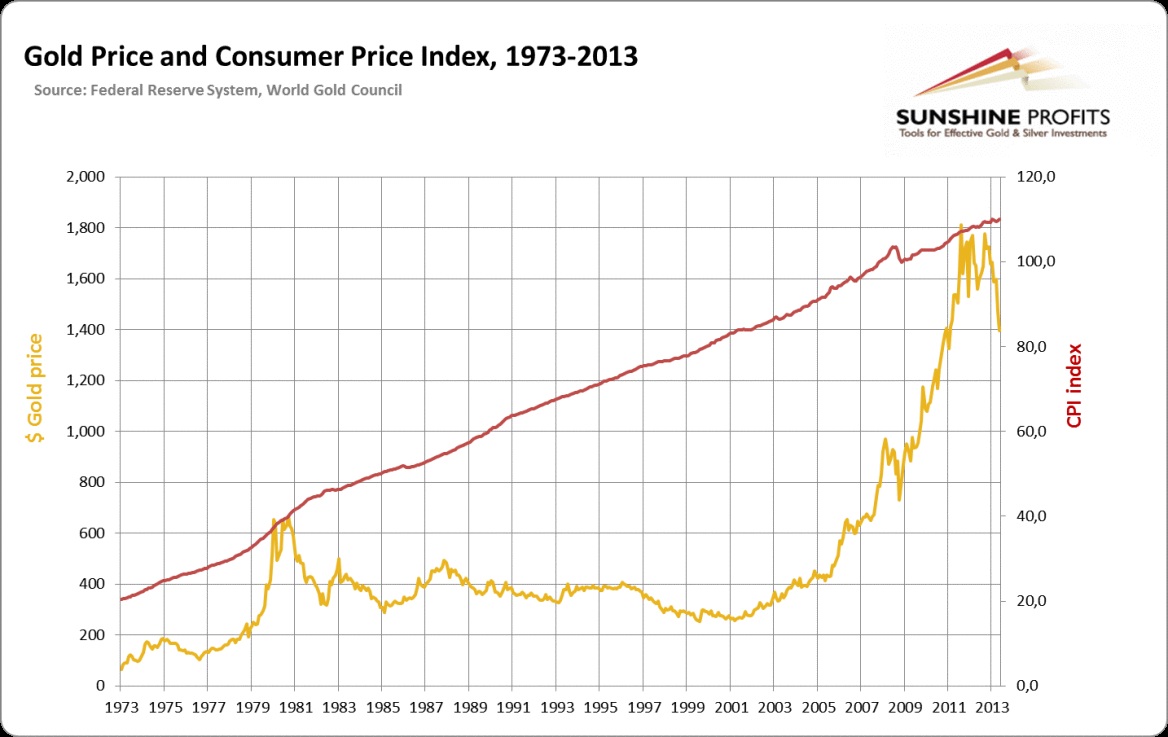
In the environment of very high levels of inflation (tens of percent) gold will rise as other real values. What is the case with single-digit inflationary scenario? Is gold really the inflation-hedge as it is touted? People believe so, and they are right when it comes to high inflation scenarios, but if we focus on smaller doses of inflation there is little correlation between the inflation rate and the gold price. Actually, as stated above gold is an anti-inflation instrument only when biginflation is on its way. Very big. The last 40 years tell us that gold has its own cycle, in fact unrelated to levels of inflation. Take a look at this graph:

For the last 40 years the dollar was constantly losing its value (right scale) sometimes faster, sometimes slower. Yet gold appears to have its own way of reacting to this steady decline in the dollar’s purchasing power. Take as an example the case of the period between 1982 to 2002 when the dollar lost half of its value. During the same period gold did not gain 100% to compensate for inflation. It did not increase and did not even stay at the same level. In fact it lost its value. It was one of the worst inflation-hedges one could pick. It did not save your capital from inflationary policies. Worse, because it was inferior to the dollar putting your green paper currency in socks was a better choice than buying gold.
Two decades is not a short run. We do not take the highest gold price from the 1980s to prove the point. During those 20 years gold was losing its value faster than the dollar. Then things changed. For the next ten years the dollar lost its value, but there was a significant shift in the gold market. During that period of time, as we well know, gold gained tremendously. Even though the time period is not very long it can clearly confirm one thing: gold has its own separate market. Its value may be related to the inflation rate, but it is not a primary reason for major shifts in the value of gold. Simply put, there is more--much more. Historically gold is not a good inflation hedge (or precisely it can be in only certain circumstances).
The key to proper understanding of the gold market and more importantly – making a correct investment choice in the gold market – is getting rid of this popular notion about the yellow metals and admitting that gold will not necessarily save you from the inflation monster. Yet it can save you from something else: the endangered dollar system.
As mentioned earlier, the above is a part of the first Market Overview report that we have just published. The full version includes detailed discussion of the anti-inflationary investing vs. anti-system investing (when is gold exactly an inflation hedge?), physical gold production, mining costs, and more. We are generally fans of the try-before-you-buy policy, so we have already provided two parts of this month’s Market Overview this and last week. We are also posting this month’s Overview later than usually so that if you sign up for the monthly subscription, you’ll be able to read 2 monthly Market Overview reports in this period. The price for one month is $14.95, but we decided to lower it for the first month to $9.95. So, instead of one for $14.95 you get two for $9.95 – that’s a 67% discount for a premium publication. We’re not saying that you have to sign up but we highly recommend that you do and given the discount, it would be a waste not to take advantage of it. You can sign up here.

Matt Machaj, PhD
Sunshine Profits‘ Contributing Author
* * * * *
Disclaimer
All essays, research and information found above represent analyses and opinions of Matt Machaj, PhD and Sunshine Profits' associates only. As such, it may prove wrong and be a subject to change without notice. Opinions and analyses were based on data available to authors of respective essays at the time of writing. Although the information provided above is based on careful research and sources that are believed to be accurate, Matt Machaj, PhD and his associates do not guarantee the accuracy or thoroughness of the data or information reported. The opinions published above are neither an offer nor a recommendation to purchase or sell any securities. Matt Machaj, PhD is not a Registered Securities Advisor. By reading Matt Machaj’s, PhD reports you fully agree that he will not be held responsible or liable for any decisions you make regarding any information provided in these reports. Investing, trading and speculation in any financial markets may involve high risk of loss. Matt Machaj, PhD, Sunshine Profits' employees and affiliates as well as members of their families may have a short or long position in any securities, including those mentioned in any of the reports or essays, and may make additional purchases and/or sales of those securities without notice.

Gold Market Update

All the pieces are in place for a major uptrend in gold to begin right away, and it appears to be starting as this is being prepared. The Commercials have cleared out virtually all of their short positions, for a massive profit of course, meaning that the slate is wiped clean for the game to start over anew. Public opinion and sentiment towards gold remains rotten, which is exactly what you expect to see at a major low, with the investing public at large, having been duly “educated” by the mainstream media, harboring a negative attitude to gold and if anything inclined to short it. Lastly, seasonal factors couldn’t be better – August and September are traditionally the best months of the year for gold.
On its 1-year chart we can see that gold had already broken out of its steep downtrend in mid-July, since which time it has been held in check by its falling 50-day moving average, which is now starting to flatten out, so that a bull Flag appears to have formed as the price retreated back along the top of the trendline that it had earlier broken above. This Flag implies another upleg, which appears to have started this morning, and this uptrend could really gain traction soon if the price breaks above the nearby resistance shown, given the huge speculative short positions that have built up and the consequent potential for massive short covering. The gap between the 50 and 200-day moving averages provides a measure of how oversold gold is. Of course, breaking above the strong resistance at the earlier major support in the $1550 area that failed back in the Spring will be a tough nut to crack, but we will have to see how gold shapes up approaching it, in order to assess the chances of an early breakout above this key level.

The long-term 13-year chart for gold shows that it is at a good point to turn up again, as it has retreated back almost to the important long-term supporting trendline shown, and also into the zone of support shown. This chart makes clear that gold is still in a bullmarket.

The latest gold COT chart is very bullish indeed. The uptick in Commercial short and Large Spec long positions last week is nothing to worry about - on the contrary it is thought to indicate the start of another bull cycle for gold which will see positions on both sides expand again as gold ascends.

The long-term gold COT chart shows an extraordinarily bullish setup for gold, with the Commercials having almost totally cleared out their short positions to a historic low, for a huge profit of course, and the habitually wrong Large and Small Specs having reduced their long positions to a very low level. All this shows that the game has been reset prior to another major uptrend starting in gold.

Chart courtesy of www.sentimentrader.com

The Hulbert Gold Sentiment chart that we have used in the past is no longer available onwww.sentimentrader.com the reason given being “Due to a request from Hulbert Financial Digest, the publishing of this chart has been temporarily suspended.” Maybe Big Money has been leaning on people – after all they wouldn’t want ordinary investors having access to information that might enable them to make decisions that turn them from habitual losers into winners. Perhaps in the future, if you want any useful charts, you will have to compile all the data yourself and make them from scratch, assuming the data itself isn’t rigged, of course. By that time I will be retired and able to laugh about it all – unless I follow Richard Russell’s example.
The latest Public Opinion chart shows that the public still hold a very low opinion of gold, and that has to be bullish.
Chart courtesy of www.sentimentrader.com

The Rydex traders are upholding their time honored tradition of providing an excellent contrary indicator – keep up the good work lads! ...
Chart courtesy of www.sentimentrader.com

The gold seasonal chart is most encouraging as it shows that we have arrived at the most seasonally bullish time of year for gold. With the middle of August approaching it’s high time gold starting rallying – and this morning it is.This positive seasonality continues through to mid – end of September.

A glance at the chart for the GDX, which we examined on the site last week in some detail, shows that something is brewing. Bearing in mind that stocks commonly lead gold, it is most encouraging to see that a basing pattern started to form in stocks as far back as the low point of the dramatic plunge in mid-April. The pattern that has been building in the GDX appears to be a downsloping Head-and-Shoulders bottom, which is more bullish than the normal flat-topped pattern, because the downward slope fools the majority of investors into thinking that a relentless bearmarket is in process – they usually notice that the market is basing. As we can see downside momentum has been decreasing as this pattern has evolved, while upside volume has been increasing, with 2 big white.

What about the dollar? The dollar’s underlying plight due to the Fed’s strident efforts to render it ultimately worthless has been masked by the mess and mayhem in Europe causing funds to head west and prop it up as the lesser evil. If that stops there could be a grim day of reckoning ahead for the dollar, particularly if other countries around the world start to grasp that it’s not particularly smart to swap good and services for piles of newly printed and intrinsically worthless paper, be they dollars or Treasuries. The days of being able to rely on an endless stream of foreign fools to supply something for nothing may be numbered.
Thus it is interesting to observe that the dollar has been rounding over gradually beneath a “Distribution Dome” on its chart, that developed following the sharp rally in mid-late 2011. While these Domes sometimes abort, that is to say the price breaks out upside from them, the only circumstance likely to cause that would be a sudden deepening of the crisis in Europe. While that is possible, the chart looks bearish at this point, especially as a bearish broadening formation or bullhorn pattern has developed on the chart in recent months. Here we should note that were the dollar to rally because of more strife in Europe, it wouldn’t stop gold from rallying – it is not generally realized that the dollar and gold sometimes rise in tandem. We should also note that if the dollar does now weaken, it is likely to be some months before the significant support in the 78 – 79 area gives way.

Ted Butler has recently written an article saying that J P Morgan have, over a period of many months, wound down a giant short position in gold, at a gigantic profit of course, and now replaced it with a giant long position. While we are of course delighted for J P Morgan, and its illustrious leaders, we are equally pleased that, if what Butler says is true, gold is heading a lot higher, because what J P Morgan (and Goldman Sachs) want, they usually get. Ted Butler’s frequent use of the term “corner” in this article, implying – perish the thought – that the market might be manipulated, is a sign that Butler may have been a football player in his younger days.
Meanwhile Adam Hamilton has written a timely article some weeks back highlighting the potential for a massive short squeeze in gold. While it helps to take an acid tab an hour or so before looking at his charts, he presents a convincing case, and it certainly looks like a blistering rally is not far over the horizon. This is good news for bulls, as it means that gold should have less trouble taking out the strong resistance at the April breakdown point than would otherwise be the case.
In conclusion we appear to be right on the doorstep of the next major uptrend in gold, silver and the PM sector, which promises to be really big, like the late 70’s only a lot more spectacular. Rising interest rates won’t stop it – on the contrary rising rates will feed it just as in the late 70’s because rising rates won’t attract people to bonds if their price is collapsing. Most investors will miss out on it, as usual, as a result of being burned by the preceding correction, and worries about that downtrend continuing, played up by the still negative media. They will turn up in droves many months down the road when prices will be much higher.
We have already looked at the bigger gold and silver stocks on the site, and the main leveraged ETFs. Soon we will be looking at options strategies involving the main ETFs and big stocks, designed to leverage gains from the uptrend. This is, believe or not, a much safer and more reliable way of achieving performance than dabbling in dodgy juniors, which or may not partake in the rally, and can collapse at any time, almost without warning.